A beautiful, clear and accessible teaching by Adyashanti on seeing the world as it is, removing the thought filters of the past so we can be fully present to what is and to what we are.
We're all walking each other Home.
A beautiful, clear and accessible teaching by Adyashanti on seeing the world as it is, removing the thought filters of the past so we can be fully present to what is and to what we are.
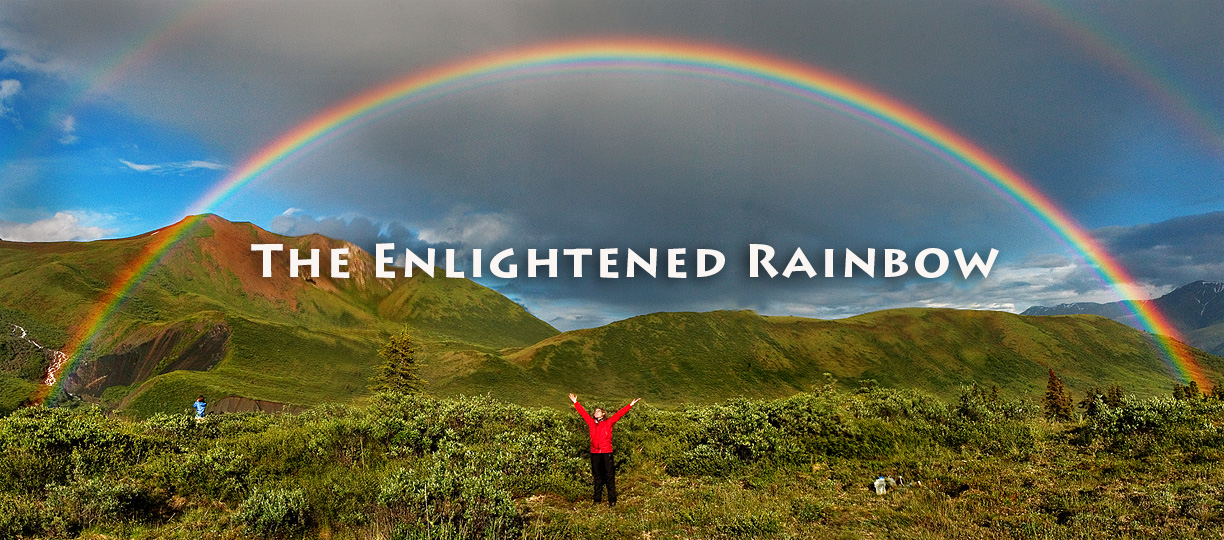
Most of us love rainbows. They are beautiful. And they also have much to teach us about life and truth. One of the reasons we love rainbows so much is because they are clearly so temporary. As soon as the sun sets, where is the rainbow? When there is less moisture in the air, where is the rainbow? Rainbows usually don’t even last for a full hour or even close to it. They appear like magic and disappear just as quickly. And this is why we love them. It’s a wonderful treat to see a rainbow because they are rare and very temporary. You better look while it’s there because it won’t be here for long.
And this temporariness is part of a rainbow’s great beauty. If a rainbow lasted for days or years, it would not have the same impact. We’d begin to take it for granted. “Oh, yes that old thing. It’s always there.” The short life of each rainbow is a big part of its appeal.
The temporariness of a rainbow points to a very important fundamental truth about all of life. It’s temporary. If you have grown children, you can remember and even have photographs of them when they were just born. They were so cute and tiny, usually weighing less than ten pounds. You could hold them in one hand. Imagine if their body remained that same size throughout their life. It would seem pretty strange when they were twenty and still weighed less than ten pounds. So the body of your child has been changing all the time. At one point they could neither walk nor talk. Now they may never seem to shut up. 🙂
Everything in life is changing. Your body will also not remain the way it is today. The lifespan of a rainbow may only be a few minutes. The lifespan of your body, including all its changes, may be eighty or ninety years. There is a difference between the lifespan of a rainbow and the lifespan of a human body. But both are impermanent. Both begin and end. It is only a matter of how long this takes.
There is something else very important about rainbows. They cannot exist without certain elements existing. If there is no sunlight, there is no rainbow. Rainbows don’t occur at night. If there is no moisture in the air, rainbows also can’t occur. Rainbows depend entirely on other things for their very existence, like sunlight and moisture in the atmosphere, among many other things. I think this is pretty clear.
We all understand this about rainbows, but we don’t really consider how much this is also true for ourselves. Just like a rainbow, there are many things that are absolutely necessary for our existence. Our body could not exist if our parents had never met for instance. And then of course there is air, water and food. It is obvious that this body could not last long without these essentials. Most of us don’t consider all the things that the very existence of this body depends on when we think of our body and ourselves as separate and independent. Just as a rainbow cannot be separate and independent from sunlight and moisture, we cannot be separate and independent from the many things that are necessary for our existence.
In Buddhism we call this the realization of non-self. Not only rainbows and bodies cannot exist separately and independently, but nothing can. The realization of non-self and the realization of impermanence are two of the universal truths that lead to awakening. These are known as two of the Three Seals. They are called Seals because they represent universal truths. The third of the Three Seals is Nirvana or the extinction of all concepts. Concepts, thoughts and language all divide the world up into separate and independent things. Since no separate and independent thing can actually exist, all concepts are fundamentally false. When all concepts are let go, we encounter the truth of life directly.
When we realize fully that a rainbow is impermanent, that it is changing all the time, even while we can still see it, and that it cannot exist independently and separately from all the other elements that are necessary for it to exist, then our concept of a rainbow dissolves. Only then can we truly see a rainbow for what it is, not separate from anything else in the universe. This is true seeing. This is the seeing of Nirvana. Each of these Three Seals (universal truths) we can realize from deeply observing a rainbow. We can actually learn this from deeply observing anything because everything contains the same universal truth. But observing a rainbow might be more fun, if you like that sort of thing. 🙂
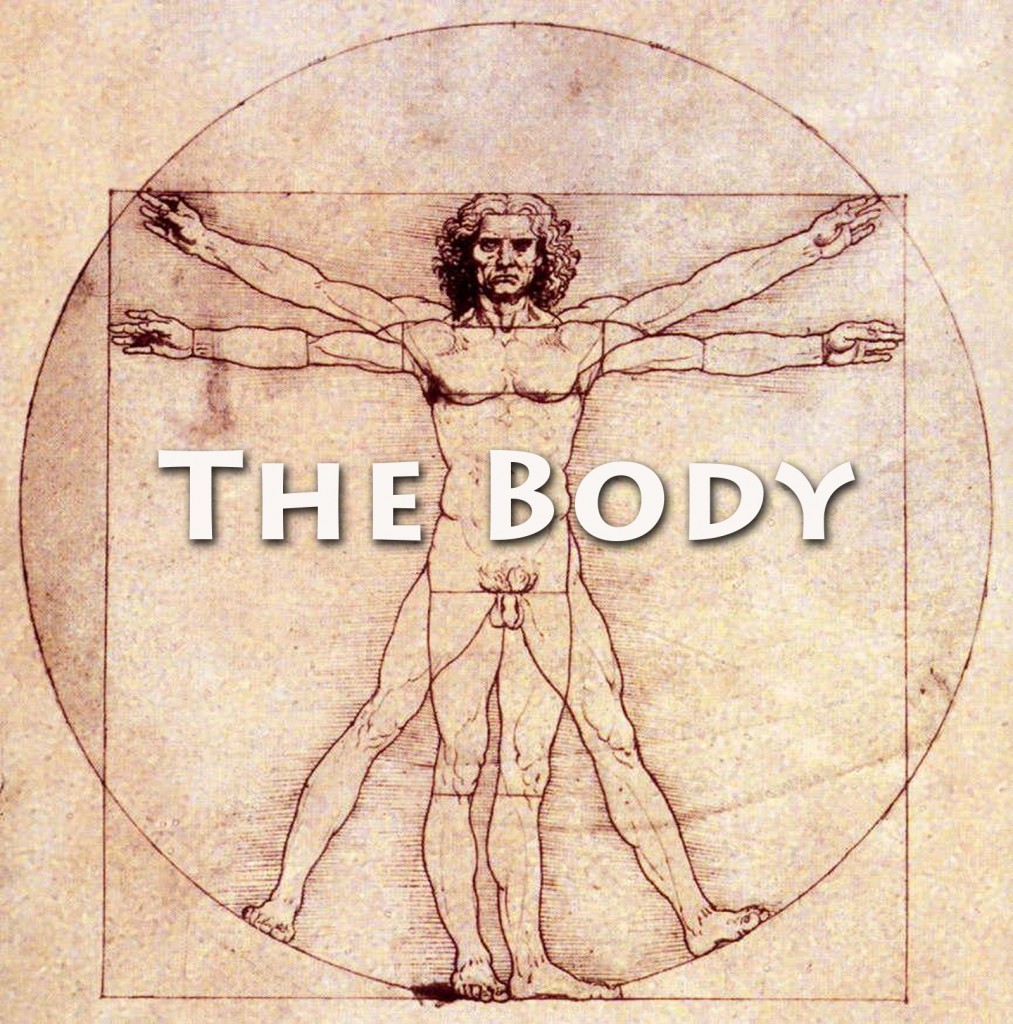
What is the body made of? If we look carefully, we can see it is made of only four elements: earth, air, fire and water.
Earth is the body’s bones, skin, teeth. Fire is the heat generated in all living bodies. Water is in our flowing blood and in every cell. The body is mostly water. And air is not only the exchange of oxygen necessary for the life of our cells, but also the vast space between molecules that is true of all physical matter. Earth, air, fire and water.
When you sit silently in nature, these four elements of the body become very clear. This body is not separate from the earth it sits on. Without this earth element, it could not exist. This body is not separate from the sun that shines on it. Without the sun, this body could not exist. This body cannot be separate from water or air. Without these the body also could not exist. If you removed even one of these elements, the body could not be here.
If you too can see this clearly, then answer me this. What is this thing you call “my body”? Is it a separate, independent thing, separate from the rest of life? How can it be? Without the earth, the sun, water and air, it cannot exist for even a single moment. So it is not separate and independent from these things. How about parents? Could this body exist if your parents had never met? And, you know, this chain of ancestors goes back a very long ways, even before the human species existed. Could this body exist without even a single one of those ancient ancestors meeting? So this body cannot really be separate and independent from any of them.
If you look carefully you cannot find any evidence at all that this body is separate and independent from anything else. Don’t take my word for it. Try it and see for yourself. Let me know if you find any evidence of this body’s separate and independent self-nature. I’m very interested in hearing what you discover.
This is all very clear, is it not? It’s quite obvious. Perhaps you have not looked at your body in this way before. You may perceive the body as separate, independent and unique. You may call it “my body” as if it really were separate from all the other bodies, from all your ancestors, from earth, air, heat and water. This experience of a separate, independent body is part of our conditioning. It is also why we feel that we are a separate, independent self separated from the rest of life. But, if we look carefully, we can see that there is no evidence for this. The evidence is, in fact, just the opposite. There is no separate, independent body, just as there is no separate, independent self.
There is a fifth element we haven’t mentioned yet. This element may not yet be so obvious. It is what animates the body, giving it what we call life. And it is also the substance of all life, including earth, air, fire and water. We have many names for this fifth element, which is not really an element at all. Some call it Spirit, Consciousness, God, the Formless, the Un-manifest, Emptiness, etc. But no name can really describe what this is. It cannot be seen and yet it is very much here. In deep silence, when you are really paying attention, when you are really listening, perhaps you can feel it. Nothing that exists is ever separate from this.
Oneness or non-duality are not really concepts at all. They are, instead, the end of concepts. They are simply freedom from the conditioned concepts of separation and independence. If you look carefully and pay attention, it is clear that separation and independence cannot exist – not in a body and not in a self. That we experience life as separate and independent is only the result of our conditioned thoughts. It is much like a sleeping dream. When we wake up, we realize this has never been true.
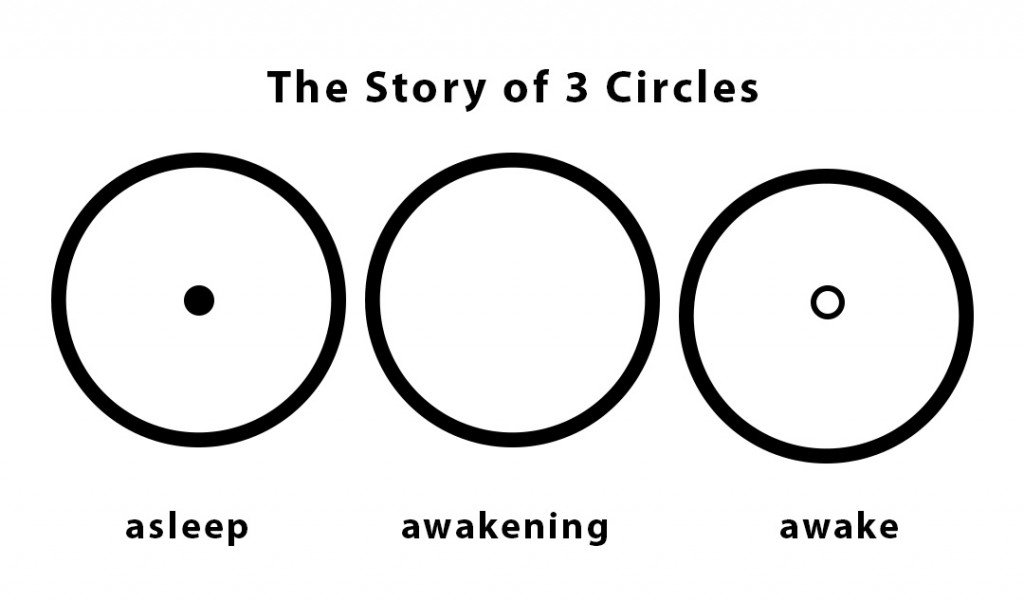
 Kensho or Satori are the Japanese terms for the initial awakening, the first taste of enlightenment. Imagine a large circle with a small dot in the center. The large circle is the universe or all that is. The small dot in the center is you.
Before this experience of awakening, you experience yourself as the dot in the center of all that is. When you look up at the stars at night, it is you looking at stars. You and stars are not the same. You are the one looking. The stars are what are being seen by you. You are here. The stars are there. The stars are outside of and separate from you. You might think something like, “I am seeing the stars.” But you never question deeply what this “I” is.
This is your experience of everything and everyone. There is you and there is the rest of the world or universe. As you can see you when you look at this circle, the universe is very large and you are very small. This is a precarious situation to live in, tiny you vs huge universe. A subtle or not so subtle experience of fear or anxiety is normal in this situation. There is also frustration and disappointment when the universe doesn’t cooperate with your wishes, needs and demands.
Is it any wonder that life seems challenging? And when it gets challenging enough, is it any wonder that some people want to wake up, to discover a different way to live? Often the spiritual search begins in just this way.
The first taste of awakening occurs when the dot in the center of the circle is erased. In Zen, we call this “dropping body and mind”. Suddenly there is no dot. There is no you. There is just the circle, just the universe, just all that is. This is such an enormous relief that we are filled with great freedom, joy, peace and love. Tears of gratitude rush forth. Bursts of spontaneous laughter erupt. Sometimes the entire body shakes with this great release, as if we had been holding it tensely our entire life up until this moment. All conditioned thoughts have been burnt up in the brilliant sun of this powerful realization of truth.
The dot of you can dissolve gradually into the vast universe over many years of spiritual practice or it can occur spontaneously in a sudden and unexpected burst as it did for me when I was just twenty-two-years-old. If we are young, immature and don’t have a strong spiritual foundation (practice, meditation, learning, teacher), this sudden and spontaneous realization usually does not last long. This was true for me as it only lasted for ten days, although it did completely alter my life. Desperate to regain this amazing experience, I set my feet firmly on the spiritual path, eventually discovering the practices and teachers necessary for a foundation that could support this realization in daily life. A spiritual foundation is not like the hard, inflexible concrete that makes up the base of a building. It must be flexible enough to continue growing, as the depth of this realization never stops growing. Even after awakening, we never stop learning.
In this first moment of realization, we realize and directly experience that there is no separate self here, nor is there a separate self anywhere else. We are not separate from anything or anyone in all existence. The love experienced from this realization is unlike anything we have ever experienced before. We are absolutely in love with all that is. We and everything else are nothing but love. It radiates from us like the sun.
If our foundation is strong, this will be more than a wonderful moment in our lives, an interesting story to tell our friends, a new way to feel special, now still separate but better. It will be the beginning of continuous growing and deepening. But what do we do with this realization? How does it serve the benefit of all? There is only the all. We fully realize that now. So how does this realization, through this unique body and mind, serve to benefit all?
Now the little dot returns. But it is entirely different. No longer feeling separate from the universe, from all that is, the dot now lives only to serve all that is. It knows its true function. And its true function is to be of benefit to all that is in every moment. There is no longer even a hint of self-serving, of I, me, mine. These things only exist as words. They no longer have any meaning. The dot is here as a vehicle, but it no longer experiences any of the separation it felt in the first circle. It is the universe. The universe is it. There is not an inch of separation anywhere.
Its actions no longer arise from the mind, from conditioned thoughts, plans, beliefs and ideas of what the right thing to do is. Now its actions arise completely spontaneously in each moment. The universe always knows what is of the greatest benefit for all in each moment. This body and mind are the perfect vehicle to carry this function out.
The mind is in a permanent and perfect state of Not Knowing or Unknowing so that it is the perfect empty vehicle for the Universe to act through.
This is what we mean by the word Emptiness. It is clear and clean, a perfect channel with no obstructions to block life from expressing itself without interference. In the first circle, the little dot believed it was separate from the rest of the universe. It had thoughts, knowledge, ideas and beliefs it had accumulated that it believed were real and important. It believed these thoughts, knowledge and beliefs were protecting it from the rest of the universe which it perceived as threatening to it. In this way, it was like a clogged pipe that water could not move through. The universe could not move freely through this separate self. It was too clogged with its own thoughts, knowledge and beliefs to realize that it never had been separate from the universe.
After erasing all the thoughts, knowledge and beliefs that created this dot as something separate from the Universe, the dot is now used as the perfect vehicle for the Universe to express itself for the benefit of all that is. It does this automatically and spontaneously. In the first circle, the dot relied entirely on the mind to make decisions and carry out actions, often for the benefit of only itself or a small circle of beings. Now the dot doesn’t rely on the mind at all and effortlessly acts for the benefit of all through the vast wisdom of the Universe Itself.
The first challenge is awakening, erasing the dot completely. Even after the first realization, it can take time to completely erase the dot, the experience of a separate self. This is why practice is important not only to awaken but for the continuous deepening into awakening and the functioning of awakening in the world.
The second challenge is embodying awakening. How does awakening function in the world to benefit all beings? The experience of a separate self disappears, but the body and mind do not disappear. They are still here. And that’s a good thing. Without a body and mind, how could we benefit all beings? It is now clear that both body and mind are also empty of a separate self. They are not self-existing entities. Just like you, they are not separate from the entire Universe. This is also true of all thought, emotions, sensations and perceptions. They are all transient, impermanent, coming and going, changing in every moment. This is the true nature of all life. And yet there is a unique body and mind, and a multitude of other bodies and minds. There are trees, rivers, rocks and mountains. All of this is here. All of this exists. It’s just that none of them have a permanent self-nature. None of them are separate from anything else. This is the great realization we discovered when the dot in the center of the circle disappeared. How this realization functions in the world of name and form is the realization in the third circle when the dot returns.
Look at your own heart. Can it be separate from your lungs that supply the heart cells and all other cells with the oxygen they need? Can it be separate from your parents or grandparents? If they never met, where would your heart be now? Is the food you eat separate from your heart? Is whether you exercise or not separate from the condition of your heart right now? Are your thoughts, beliefs and emotions separate from your heart? If you are able to see your heart clearly, you will realize that nothing in all existence has ever been separate from your heart. The same is true of your brain, your kidneys, your liver, your stomach and intestines. In western medicine we like to think of the heart as an organ separate from the lungs, brain, kidneys and liver. But can this really be true? Everything in your body is connected and depends on every other part for its health and its very existence. If western medicine were more aware of this, there would be far less malpractice suits and a far healthier population.
This body is not separate from you. And you are not separate from this body. Nor are you separate from any other body. Without trees, you would not have the oxygen for your lungs to breath clean air. Without the sun, you would have no trees or food. We are completely dependent on all other things for our existence. There is no separation anywhere. Thich Nhat Hanh has created the word inter-being to describe this. We inter-are with all of existence.
When the dot at the center of the circle dissolves, at first we feel we are infinite space. Everything that exists arises in and returns to this infinite space that we are. Then we notice that this space also has no separate, independent self-nature. The space depends on all the things that appear in it. And all the things that appear depend on this space.
The western language is built on duality. Everything has its own name and all these names and the things they describe are separate from each other. Each name has a separate, independent self-nature. But after we awaken, we realize that this is not true. Using western language to describe this realization is not easy. To the unawakened mind, it often sounds like zen poetry or a metaphor.
I am a glint of sunlight reflected off the windshield of a passing car.
I am the cicadas heralding the coming autumn.
I am the sound of raindrops on a tin roof.
This may sound like poetry, a metaphor or a cryptic Zen koan.
But I assure you it is simply a statement of basic truth. All things are one with everything else.
We might also say, “I am you. But I am not me.” Again, this can sound confusing if we still believe that things have a separate, independent self-nature.
When we believe everything has a separate self-nature, we say that mountains are mountains and rivers are rivers. When we first realize this is not true, we might say that mountains are rivers and rivers are mountains. They inter-are. To apply this understanding in the world for the benefit of all, another step is needed. I may see that mountains are indeed rivers and could not exist without rivers and all existence. But when I climb a mountain, I do not swim up it. So the functional application of mountains are rivers is that mountains are mountains and rivers are rivers. I climb the mountain and I swim in the river. Awakening does not mean we have gone insane or that we can no longer function in the world. In fact, we function far better than we did before.
Here are some links to help you delve deeper into the awakening process and the discovery of your infinite True Self.
Map of Consciousness – Journey to Awakening
 At this point you want to begin a meditation practice. Meditation will be part of your practice throughout your spiritual journey, although it will change a great deal along the way. Each level of awakening calls for a different type of meditation practice, but the foundation for all meditation is built in these simple beginning practices.
You will need to begin with the most basic meditations that simply increase your ability to concentrate and focus your attention. Most of us were never taught to do this in an effective way. Up until now your mind and thoughts have been controlling your attention. You haven’t noticed this because you thought this was you. Now you’re going to learn to change this and put yourself back in the driver’s seat. These simple meditation practices will help you do this. But you need to be disciplined and consistent in doing them. Begin with five minutes first thing in the morning and at night before you go to bed. Any time during the day when you can spare a few minutes do them then. Make a commitment. It will pay off in ways you cannot now imagine.
As you feel ready move to 10, 20, 30 minutes. The more time you put in, the more effective they will be. Don’t tire yourself out. Don’t make it a burden. It will be challenging to begin with, but the more you practice the easier it will be. And the payoff is worth it.
Sit in a quiet place where you won’t be disturbed. Meditation is traditionally practiced sitting on the floor. There are several traditional sitting positions for the floor: cross-legged, lotus position, half lotus, quarter lotus, Burmese and kneeling. Each of these postures are illustrated here. Yoga can help increase your flexibility for these postures. If you are not flexible enough to sit on the floor, use a chair. Keep your back straight, but relaxed. Image there is a string attached to the center of your head effortlessly pulling it upward. Sit in a position that is comfortable for you. Don’t strain. This is not an endurance contest. Enjoy it.
Click here to see the meditation postures.
Meditation is a practice you will be doing throughout your entire spiritual journey, so develop a strong solid foundation. You want to be as comfortable as possible. If you are sitting on the floor, you want to have a good cushion (zafu) and a mat (zabatan) to keep your feet and knees comfortable. Here is a high quality traditional cushion and mat to get you started. At $150 for the set, it’s not the cheapest option. You can search Amazon for less expensive ones. But for comfort and reliability, it’s a good investment. You can choose either kapok or buckwheat to fill the cushion. Kapok is firmer, like cotton batting. The buckhwheat hulls conform to the shape of your body. The set comes in a variety of colors. Click here to see this set on Amazon.
The first basic practice is simply to count your breaths. This is the practice of concentration. The breath is always available to you. Place your attention on your breath, your in breath and out breath. Breathing in, I know I am breathing in. Breathing out, I know I am breathing out. Notice how your belly rises when you breath in and falls when you breath out. Notice how the air feels as it moves past your nostrils. These are simple things you may not have paid attention to before. Place your focus here now.
Begin to count each out breath from one to ten. If a thought distracts you and you lose count, begin again at one. Continue doing this for five minutes. After a short time, you should notice a peace arising in you, a calmness. This is because you are not living in your mind, in your thoughts while you are doing this simple practice. When you are completely focused on your breath, on your in breath and out breath, you are present. And being present feels good. Now you are already experiencing the benefits I promised you. It’s wonderful, isn’t it? Keep practicing.
The more you practice this very simple exercise, the easier it will become, the less you will be distracted by thoughts and the more peace and calm you will experience.
Here is a simple Gatha for practicing with the breath that Thich Nhat Hanh teaches.
Breathing in, I know I am breathing in.
Breathing out, I know I am breathing out.
(After awhile, just use one word for the in breath and one word for the out breath.)
In.
Out.
You may like to use this Gatha to get you started. After a while, just focus on the breath without any words.
Once you are very good at counting your out breath to ten without being distracted, you can make it a little more challenging. This will increase your ability to concentrate and focus attention even more.
Count your out breaths to seven. Start back at one and this time double it to fourteen. Start back at one and add another seven to twenty-one. If you get distracted and lose count, go back to one and start over to seven. Continue doing this to as high a number as you can go. Perhaps105 or more. See how far you can go. Make it fun. Relax. Don’t try too hard. Enjoy.
Now that you are able to count your breaths pretty well without being distracted by thoughts, your ability to concentrate has improved enough for the next meditation. This ability may take some time. So don’t jump the gun. If it takes six months; it takes six months. If it only took a few weeks; it only took a few weeks. Be honest with yourself.
In this meditation, you are simply going to focus on your breath, without counting. Just put your focus on your breath. And you are going to watch your thoughts arise and pass without getting lost in them or following the “thought story”. Just let them come and go like clouds effortlessly coming and going in a vast blue sky. You are the vast blue sky that these thoughts are passing through. Let them come and go without distracting you from the rising and falling of your breath. This practice is to help you begin to free yourself from your attachment to and identification with your thoughts.
Up until now you believed your thoughts were you. That voice in your head was you. It’s not. Your thoughts are not who and what you are. They are just thoughts. They are JUST thoughts, nothing more. That incredibly important thought that will save the entire world or solve all your problems, it’s just a thought, nothing more than a thought. It’s not you. You are the one aware of the thought. Let all thoughts come and go in this infinite blue sky that is you.
That thought that says, “I can’t do this.” It’s just a thought, nothing more than a thought. It’s not you. You are the one aware of the thought. You are the one watching the thought. Let all thoughts arise and pass through this infinite sky of awareness that is you.
As you become aware that your thoughts are not you and you can successfully observe them coming and going without attaching to them, you begin to wonder what is it that’s aware of these thoughts. Previously you thought you were your thoughts. Now you realize you’re not. So what are you? That question and the awareness of that question brings you to the next stage in awakening and the next meditation practice – becoming aware of awareness itself.
Here are some good beginning meditation books to get you started. I chose books by Thich Nhat Hanh because I think these are the best for a beginner. Their simple, gentle, loving and encouraging style have launched many people onto a solid meditation practice. Enjoy.
Making Space – Creating a Home Meditation Practice by Thich Nhat Hanh
The Miracle of Mindfulness, a wonderful, simple book by Thich Nhat Hanh about beginning a meditation practice.
The Blooming of the Lotus is a book of Gathas, meditation phrases, to help you get started.
The Posture of Meditation, a book by Will Johnson that will help you align your meditation posture no matter what posture you take.
The Three Pillars of Zen by Roshi Philip Kapleau is a Zen classic. It is a book you will keep throughout your spiritual journey. Among its description of Zen practice and the enlightenment experiences of many students, there is a wonderful description of all the traditional sitting postures and how to do them.
If we are to set out on a journey, it’s a good idea to have a map of where we want to go. If it is a new journey, there are places on the map we have not yet discovered. These places are completely unknown to us. Friends may have described some of these places, but all we really know is that they sound interesting and seem worth directly experiencing. Other places on the map we know pretty well. We’ve spent some time there. And still other places we have only briefly glimpsed through the car window as we passed by.
This map of consciousness is like this. Some places you are very familiar with. It is where you live or where you have lived before you moved on to this new place. Some places you have just had short glimpses of. And other places you have not yet experienced at all.
On our spiritual journey it is important to know where we are and where we used to be. Where we used to be is the state of consciousness we transcended to get to the state of consciousness we live in now. Where we are is the state of consciousness we live in now. There are also states of consciousness we have had brief glimpses of in meditation, on retreats, while reading a spiritual book or just in daily life. These are brief glimpses of a higher state of consciousness but they have not yet become the state of consciousness we live in. And then there are still higher states of consciousness we have not yet experienced at all.
This map is useful to show us where we are, where we have been and where we are going. States of consciousness are more dynamic than physical places on a map. Even in the very beginning of our journey, we may have powerful glimpses of very advanced stages. In Zen, we often call these brief experiences Kensho or Satori. Because these glimpses of our True Nature have not yet been integrated, they are usually very short and not yet our day-to-day experience. This makes a map like this, along with the advice and practices for each stage, particularly useful.
It should be obvious that we can only describe where we are and where we have been. Where we have yet to be we cannot describe, just as on a physical map. We can describe the brief glimpses we had through the car windows in passing, but these will be limited and superficial. We’re actually pretty good at describing and understanding where we used to be from the higher vantage point of where we are now. We’re actually not that good at describing and understanding where we are now when it comes to consciousness. And we’re much less capable of understanding those brief glimpses. Limited as it is, this makes a map like this quite useful.
Don’t think of these as hierarchies or any form of judgments. Higher and lower are just words. To the awakened mind, they have no meaning. I use the words higher or lower because it makes it easier to understand. At some point in consciousness, the meaning of language falls away. Certainly in Oneness, all hierarchies must dissolve.
And here’s something very important to realize. You are already at the highest state of consciousness. In fact, you are this highest state of consciousness. This is what you truly are, your True Self, although you may not be aware of it yet. And that’s what the map is for, to show you what you already are but simply are not consciously aware of yet. The truth is you are already at the final destination. The map is just one of several tools to help you realize this. Even this map cannot show you what the final destination actually is if there even is one. Like all journeys, the spiritual journey is an ongoing process that has no end.
You can view this map in two ways. You can see it from Stage One, The Dream, to Stage Seven, Living Awake, as the progression you are taking to realize what you truly are. Or you can view it from Stage Seven to Stage One to begin with what you truly are and see the various stages that obscure this but are always included in it. Look for where you currently are on this map and where you have already been. It will be easy to see where you are because where you have been will be very clear. Where you are may be a little less clear. We always see the previous stage in our evolution with more clarity than the stage we are on. Also notice the stages you have had brief glimpses of from time to time but do not live at yet. Everything comes from pure consciousness, so it is natural to have glimpses of higher stages of consciousness even though that is not your normal day-to-day experience. These brief glimpses show you where you are heading.
At each higher level of consciousness you will experience greater freedom, spaciousness, inner silence and stillness, peace, love leading to unconditional love and happiness leading eventually to bliss. Each higher level of consciousness comes from surrendering the limitations and restrictions of the current level of consciousness. The path of awakening is a continuous letting go. Beginning in Stage One, Consciousness as Ego / The Dream, specific meditation practices help us move to the next stage. By Stage Four, Consciousness as Love / Something More, meditation becomes a natural part of living rather than something we do. It becomes more of our natural state.
Click here for the Map of Consciousness